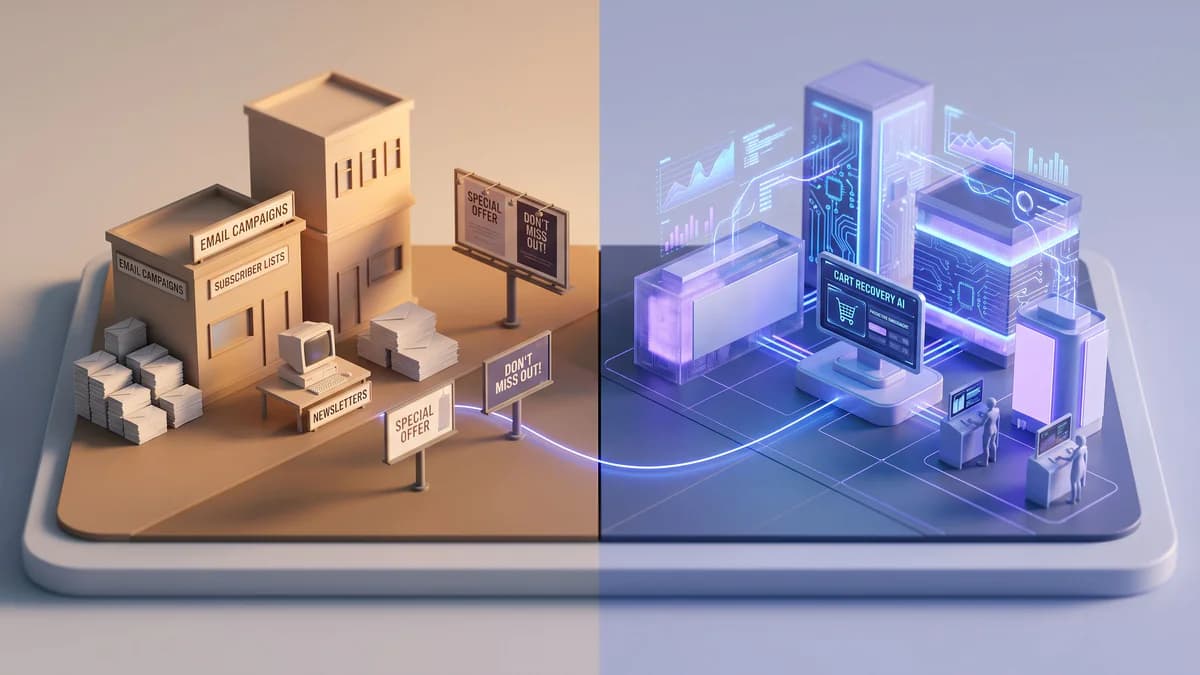
With $260 billion in recoverable revenue sitting in abandoned carts annually, the average cart abandonment rate across all industries remains 70.19% in 2026, yet the methods merchants use to recover that revenue vary dramatically, according to Digitalapplied. Understanding the AI ROI potential is critical for any e-commerce business trying to maximize revenue from lost sales. The real question isn't whether to invest in cart recovery, it's which approach actually delivers results. AI-powered solutions are reshaping the landscape, but traditional email and retargeting methods remain the foundation of most recovery programs. Comparing these strategies in 2026 is essential for optimizing your recovery approach.
AI-Powered Cart Recovery: Real-Time Intervention Before Abandonment
AI cart recovery operates on a fundamentally different principle than traditional methods. Instead of waiting for a customer to leave and then trying to win them back, AI systems predict abandonment and intervene before it happens.
AI-powered cart recovery recovers 30-38% of abandoned carts by intervening in real time before the shopper leaves, compared to traditional email's 3-5% post-abandonment rate, according to Omnisend. This dramatic difference stems from two structural advantages: coverage and timing.
Coverage advantage: Traditional email cart recovery reaches only 15-20% of abandoning visitors, those who provided an email before leaving, while AI cart recovery systems reach 100% of visitors using behavioral signals, with no email address required. For a store with 1,000 daily visitors and a 70% abandonment rate, traditional email can only contact roughly 105 people, according to Zerocartai. AI reaches all 700 abandoning visitors.
Timing advantage: AI-powered exit-intent predicts abandonment 2-4 seconds before the user actually decides to leave by analyzing dozens of behavioral signals in real time, giving you a window to intervene with the right message before the shopper mentally checks out. This is fundamentally different from email, which triggers 30-60 minutes after the cart is abandoned.
The critical finding from 2026 data is the widening gap between AI-optimized and standard template-based recovery emails, a difference that has doubled since 2024. 29% of merchants use AI recovery in 2026 (up from 11% in 2024), with early adopters reporting 2.3x higher recovery ROI compared to traditional methods.
The mechanisms of AI recovery vary. Some systems use on-site chat to answer questions before checkout. Others deploy behavioral exit-intent popups. The most sophisticated use multi-channel orchestration combining real-time intervention with follow-up email and SMS sequences.
Traditional Methods: Email, SMS, and Retargeting
Traditional cart recovery relies on three proven channels: email automation, SMS, and paid retargeting ads. These methods have been refined over more than a decade and remain the backbone of most e-commerce recovery programs.
Email recovery is the most established channel. Cart recovery emails remain the highest-performing recovery channel by revenue per message. Klaviyo's 2024 benchmark data from over 143,000 flows puts average revenue per recipient at $3.65, the highest of any automated flow, with top-performing brands reaching $28.89 per recipient.
However, the baseline conversion rate is modest. Abandoned cart emails convert at 3.33% on average, with top performers reaching 7.69%. A well-structured three-email sequence recovers 15-30% of abandoned carts at a cost of roughly $0.01-0.05 per email sent.
AI-driven cart recovery emails achieve an 8.17% conversion rate compared to 4.1% for standard template-based emails, with machine learning models that optimize send timing, subject lines, and product recommendations being the primary driver of this gap.
Email automation benchmarks for 2026:
- Abandoned cart emails achieve a 50.5% open rate (Klaviyo)
- Sending three abandoned cart emails results in 69% more orders than sending just one
- Stores that send the first email within 60 minutes recover 3x more carts than those who wait a day
SMS and multi-channel recovery add significant lift. On average, only 6.1% of abandoned carts are recovered via email, but when brands combine email and SMS recovery campaigns, recovery rates can increase to 8.4%-24.3%. Stores using both SMS and email together see approximately 30% higher customer lifetime value than stores using one channel alone, according to Braze.
Paid retargeting (Google Ads, Meta) remains a supporting channel. The optimal sequence is: push notification (15 min), email (1 hr), SMS (24 hr), retargeting (48 hr). Retargeting works best as the final touchpoint, after email and SMS have had their chance to convert.
Key Differences: Coverage, Timing, and ROI
The core differences between AI and traditional methods come down to three factors:
1. Audience Reach
Traditional email reaches 15-20% of abandoners. AI reaches 100% of visitors. For a business with $500K in annual revenue and 70% abandonment:
- Email recovery recovers $58K-$117K (5-10% of abandoned value)
- Multi-channel AI recovery recovers $234K-$410K (20-35% of abandoned value)
- The incremental multi-channel lift over an email-only approach is about $176K-$293K per year
2. Intervention Point
Traditional methods react after abandonment. AI acts before. AI introduces pre-abandonment prevention: AI chat can detect hesitation signals before the shopper exits, and a product question that goes unanswered becomes an abandoned cart while an AI that answers the question in 3 seconds converts the session. Proactive chat on cart and checkout pages catches 3-5% of potential abandonments before they occur.
3. Revenue Per Contact
Merchants using AI recovery report 63% higher revenue per email sent. This difference compounds when you factor in higher conversion rates and the ability to reach 100% of visitors instead of 15-20%. The AI ROI advantage becomes increasingly significant as you scale your recovery operations.
When to Choose AI-Powered Cart Recovery
AI recovery makes sense if you have:
- High traffic volume: With thousands of daily visitors, the 3-5% improvement in per-visitor recovery rate compounds into meaningful revenue
- High cart abandonment: If your abandonment rate exceeds 65%, the upside from catching customers before they leave is substantial
- Checkout friction: If customers are asking questions during checkout (shipping costs, product fit, return policies), AI chat solves this in real time
- Mobile-heavy traffic: Mobile cart abandonment stands at 76.98% compared to 64.78% on desktop, a 12.2 percentage point gap. AI's real-time intervention is especially effective for mobile users who are more likely to abandon
- Resource availability: You have the technical capacity to implement and monitor a more complex system
Implementation considerations:
- Setup is more complex than email alone; most platforms require integration with your e-commerce system
- Most stores that deploy a full workflow reach breakeven in the first month
- Requires ongoing optimization of behavioral triggers and messaging
- Combines multiple technologies (chat, exit-intent, email, SMS), so you need a platform that orchestrates all channels
When to Choose Traditional Methods
Traditional cart recovery is the right choice if you:
- Are just starting: Email automation is the fastest path to recovery. Recovering a $75 abandoned cart costs roughly $0.50 in email and automation expenses, a 150x return, making cart recovery the highest-ROI marketing channel most eCommerce stores underinvest in
- Have limited budget: Email and SMS are cheaper to implement than full AI systems. You can start with email, add SMS, then layer in retargeting
- Have strong email list quality: If most abandoners provide their email, traditional email recovery captures most of the opportunity
- Prefer simplicity: Email automation platforms (Klaviyo, Omnisend, Klaviyo) are straightforward to set up and manage
- Have lower traffic volume: For stores with fewer than 1,000 daily visitors, the marginal gain from AI may not justify the added complexity
- Are already optimizing email heavily: If you've already achieved 50%+ open rates and 7%+ conversion rates on abandoned cart emails, additional AI layers show diminishing returns
Why traditional methods still work:
Companies that actively invest in cart recovery win back an average of 5.9% of all abandoned orders, and with the right strategy, that number can climb substantially higher. eCommerce businesses with a mature abandoned cart strategy, including email sequences, retargeting and checkout optimization, generate an average of 12% more revenue than comparable businesses without one.
Our Recommendation: A Hybrid Approach
The most effective cart recovery strategy in 2026 combines both approaches. Start with traditional email automation as your foundation. Add SMS to increase recovery rates. Then layer in AI-powered interventions as your traffic and abandonment volume justify the investment.
Phase 1: Email Foundation (Month 1-3)
- Implement a three-email abandoned cart sequence
- Send the first email within 60 minutes
- Segment by product category and customer value
- Target 15-30% recovery rate
Phase 2: Add SMS (Month 2-4)
- Send SMS 24 hours after cart abandonment
- Target opted-in customers only
- Expect 8-24% combined recovery rate across email and SMS
Phase 3: Layer in AI (Month 3-6)
- Deploy on-site chat for pre-abandonment intervention
- Add behavioral exit-intent popups
- Implement AI-powered subject line and send-time optimization
- Target 25-40% total recovery rate across all channels
AI adoption is projected to reach 58% by 2028 as platform-native tools lower implementation barriers. The trend is clear: AI recovery is becoming the default. But traditional methods remain the backbone that makes any recovery strategy work.
The real competitive advantage in 2026 isn't choosing one or the other. It's orchestrating both intelligently, using AI to catch customers before they abandon, then using email and SMS to convert those who slip through. That integrated approach is what separates stores recovering 5-10% of abandoned revenue from those recovering 30-40%.
Ready to build a cart recovery strategy that works for your business? Whether you're starting with email automation or implementing a full AI-powered system, the key is getting started now. The stores that act on this opportunity in 2026 will have a significant advantage over competitors still relying on single-channel approaches.
If you would rather hand this work to a team, start with our marketing services for Houston businesses.
Let's Discuss Your Strategy