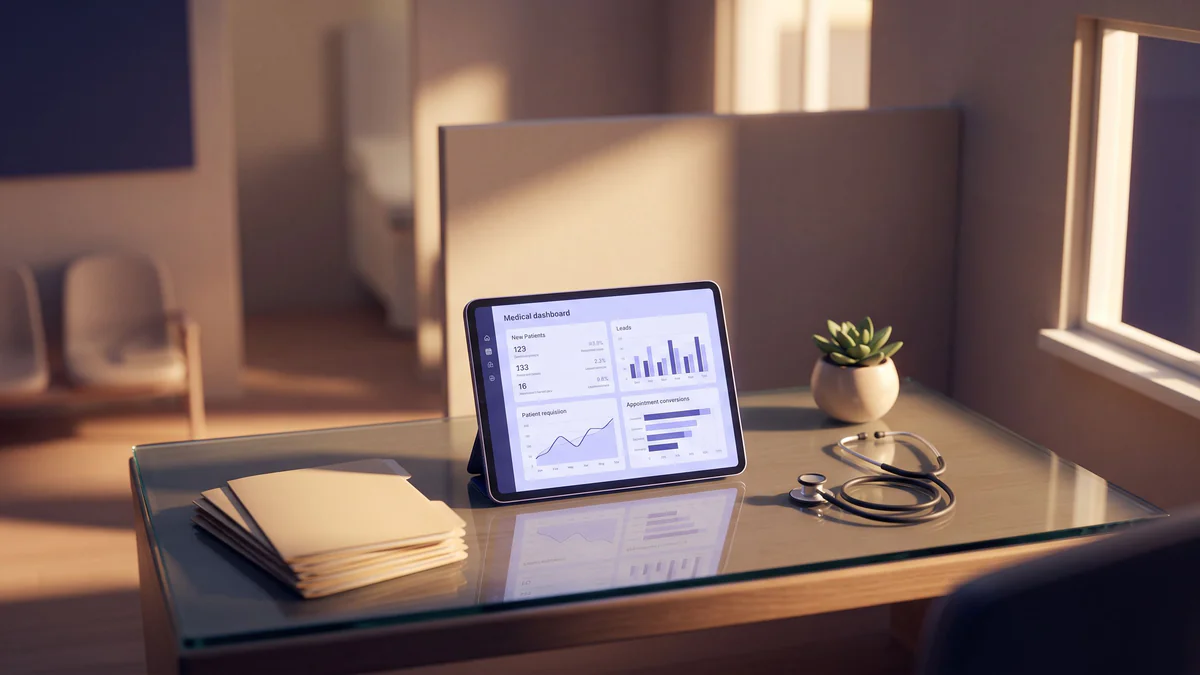
AI is fundamentally reshaping how healthcare practices acquire and convert patients. With 66% of U.S. physicians already using AI tools in practice and healthcare organizations leveraging predictive analytics seeing average ROI of 147% within three years, the competitive advantage now belongs to practices that integrate AI into their medical practice marketing strategy. This guide walks you through the complete framework for implementing AI-powered patient acquisition in 2026, from predictive targeting to appointment automation, according to Business.
Understanding AI-Powered Patient Acquisition for Healthcare Practices
AI-powered patient acquisition uses machine learning, predictive analytics, and automation to identify high-intent patients, deliver personalized messaging, and convert prospects into scheduled appointments. Unlike traditional marketing, which relies on broad targeting and reactive optimization, AI patient acquisition works predictively, identifying patients based on behavioral signals and health patterns before they actively search for care.
As artificial intelligence reshapes how patients find and choose their providers, practices that adapt their patient acquisition strategy will capture market share while competitors struggle to maintain visibility. The shift is significant: 66% of U.S. physicians already using AI tools in practice represents a 78% increase from just 38% in 2023, according to the American Medical Association.
The financial case is equally compelling. Healthcare organizations that integrate advanced analytics see an average ROI of 147% within three years. For independent practices specifically, this translates to lower cost-per-acquisition, higher appointment completion rates, and more predictable patient flow.
Step 1: Map Your Current Patient Acquisition Costs and Benchmarks
Before implementing any AI system, you need a baseline. Understanding your current cost per acquisition (CPA), patient lifetime value (PLV), and conversion rates at each stage of the patient journey is essential to measuring AI's impact, according to Medicaleconomics.
Calculate these four metrics:
-
Cost Per Acquisition (CPA) - Total marketing spend divided by number of new patients acquired in a period. For healthcare practices, typical CPA ranges from $150-$500 depending on specialty and geography.
-
Patient Lifetime Value (PLV) - Total revenue a patient generates over their lifetime with your practice. The 3:1 PLV to PAC ratio is a recommended benchmark, meaning your patient lifetime value should be at least three times your acquisition cost.
-
Lead-to-Patient Conversion Rate - The percentage of leads (inquiries, form submissions, calls) that become scheduled appointments. Healthy practices typically see 20-40% conversion rates; AI systems often push this to 35-60%.
-
Appointment Completion Rate - The percentage of scheduled appointments that result in the patient actually showing up and beginning care. This is where appointment automation and reminders drive significant impact.
Essential patient acquisition metrics for healthcare marketers in 2026 include cost per lead, cost per acquisition, lead-to-patient conversion rate, lifetime value to acquisition cost ratio, and channel-specific performance indicators. These metrics provide visibility into both campaign efficiency and overall marketing ROI.
Pull 12 months of historical data from your CRM, billing system, and marketing platforms. Segment by acquisition channel (Google Ads, local SEO, social media, referrals) so you understand which channels drive the highest-quality patients at the lowest cost.
Step 2: Implement Predictive Analytics to Identify High-Intent Patient Segments
Predictive analytics is the foundation of AI-powered patient acquisition. Instead of casting a wide net, you're using historical patient data and behavioral signals to identify who is most likely to convert and become a valuable long-term patient.
Here's how predictive analytics works in practice:
Your system analyzes patterns from past patients: demographics, search behavior, appointment booking patterns, treatment completion, and lifetime value. Machine learning models then identify similar prospects in your target market and score them by conversion likelihood. This allows you to concentrate your ad spend on the highest-probability prospects.
Predictive analytics has emerged as a transformative force in medical practice marketing. It uses data, machine learning, and behavioral patterns to forecast future patient needs, identify high-value audiences, and optimize marketing activities across every digital channel.
For example, a dermatology practice might discover that patients aged 35-55 who search for "skin cancer screening near me" convert at 45%, while younger patients searching for "acne treatment" convert at only 12%. Predictive models surface these patterns automatically, allowing you to bid more aggressively on high-intent keywords and allocate budget accordingly.
Three predictive analytics applications for healthcare marketing:
-
Audience Segmentation - AI groups prospects by likelihood to convert, allowing you to tailor messaging and bid strategies to each segment. High-intent segments get premium ad placements; nurture segments get educational content.
-
Optimal Timing - Predictive models identify the best time to reach prospects (day of week, time of day, season) based on historical conversion data. This improves ad relevance and reduces wasted impressions.
-
Channel Attribution - AI traces which touchpoints (search ads, organic search, social, email) actually drove conversions, revealing which channels deserve more budget and which are underperforming.
Step 3: Automate Appointment Conversion and Follow-Up
Once you've identified high-intent prospects, the next critical step is converting them into scheduled appointments. This is where AI-powered appointment systems and automated follow-up sequences dramatically improve results.
According to Bain & Company's 2024 analysis, AI now influences nearly half of all digital marketing activity across the healthcare sector. Yet many practices still rely on manual scheduling, delayed callbacks, and inconsistent follow-up, creating friction that costs them patients.
Implement these three automation layers:
-
AI-Powered Chatbots for Instant Responses - When prospects land on your website or message your practice, an AI chatbot responds immediately, answers common questions, and qualifies the lead. This 24/7 availability captures patients who would otherwise move to competitors. Chatbots also collect structured data (symptoms, insurance, availability) that improves handoff to your scheduling team.
-
Intelligent Appointment Scheduling - Instead of prospects navigating a confusing booking system, AI scheduling tools offer available times based on provider capacity, patient preferences, and appointment type. One-click booking dramatically increases conversion. Patients who can book instantly convert at 3-4x higher rates than those who must call.
-
Automated Confirmation and Reminder Sequences - AI sends appointment confirmations, pre-visit intake forms, and reminder messages at optimal times. This reduces no-shows by 20-30% and ensures patients arrive prepared, improving visit quality and satisfaction.
AI systems deliver the best results when they are reviewed consistently, not constantly replaced. Their effectiveness improves with disciplined evaluation cycles that align with your broader marketing rhythm. A quarterly cadence keeps AI aligned with practice goals without overwhelming staff.
The combined effect is significant. Practices implementing these three layers typically see appointment conversion rates improve 25-40% within the first 90 days, with no-show rates dropping 20-30%.
Step 4: Integrate AI-Driven Search Visibility and Local Optimization
Patient acquisition in 2026 happens across multiple discovery channels: Google Search, Google Maps, AI-generated search summaries, and review platforms. AI systems now influence how practices appear in all of these places, making visibility optimization essential.
Four visibility tactics powered by AI:
-
AI-Optimized Local Listings - Your Google Business Profile, Apple Maps, and other local directories are scanned by AI systems that power patient discovery. Ensure listings are complete, consistent, and optimized for the keywords patients actually search. AI tools now automatically identify missing information and suggest improvements.
-
Content for AI Summaries - Google's AI overviews and other AI-generated search summaries are becoming the first thing patients see. These summaries pull from your website, reviews, and structured data. Create content specifically designed to appear in these summaries: clear answers to common questions, patient testimonials, and specialty information.
-
Reputation and Review Optimization - AI ranking systems heavily weight patient reviews and ratings. Systematize review collection through automated requests sent to patients post-visit. Respond to all reviews (positive and negative) to signal active practice management.
-
Schema Markup and Structured Data - Implement healthcare-specific schema markup on your website (provider credentials, services offered, insurance accepted, appointment availability). This helps AI systems understand your practice and rank you appropriately.
Practices appearing in local pack results for relevant searches gain significant visibility advantages over competitors. The investment in local optimization pays dividends across multiple AI-powered discovery channels.
Step 5: Build a Closed-Loop Attribution and Optimization System
The final piece of the AI patient acquisition puzzle is measurement and continuous optimization. Without clear attribution, you can't determine which tactics drive ROI, and you'll waste budget on underperforming channels.
Implement these measurement components:
-
Multi-Touch Attribution - Track every touchpoint a patient encounters before scheduling an appointment. Did they see a Google Ad, visit your website, read a review, and then call? Attribution modeling reveals the true contribution of each channel, not just the last click.
-
Closed-Loop CRM Tracking - Ensure your CRM is connected to your marketing platforms (Google Ads, Meta Ads, email, landing pages). When a prospect schedules an appointment through a specific channel, that data flows back to the platform, allowing AI to optimize based on actual conversions, not just clicks.
-
Quarterly Performance Reviews - Healthcare practices should review patient acquisition benchmarks quarterly, aligned with budget planning cycles and campaign optimization windows. This cadence balances the need for actionable insights against statistical significance requirements for meaningful performance comparison. Quarterly reviews should assess channel performance, cost trends, conversion rate changes, and competitive landscape shifts.
-
AI-Driven Budget Allocation - Once attribution is clear, AI systems automatically reallocate budget toward highest-performing channels and audience segments. This happens continuously, not quarterly, ensuring your spend always targets the most effective tactics.
The result: over time, your cost per acquisition drops while conversion rates and patient quality improve. Practices with mature attribution systems often see CPA decrease 30-40% year-over-year while simultaneously improving appointment show-up rates.
Common Mistakes to Avoid When Implementing AI Patient Acquisition
1. Launching AI without a clear baseline - You can't measure AI's impact if you don't know your starting point. Establish metrics before implementation, not after.
2. Treating AI as a set-it-and-forget-it solution - AI systems require ongoing monitoring and adjustment. Set a quarterly review cadence and stick to it. Markets change, patient behavior shifts, and your AI models need to adapt.
3. Focusing only on acquisition cost, not patient quality - The cheapest patient isn't always the best patient. Monitor lifetime value, treatment completion, and satisfaction alongside CPA.
4. Neglecting data quality - AI is only as good as the data feeding it. If your CRM has incomplete patient records, inconsistent data entry, or poor attribution, AI models will produce poor recommendations. Invest in data hygiene first.
5. Implementing too many tools at once - Start with one or two high-impact AI applications (predictive analytics + appointment automation, for example). Master those before adding additional complexity.
6. Ignoring patient privacy and compliance - Healthcare data is highly regulated. Ensure any AI platform you use is HIPAA-compliant and transparent about how patient data is used. This builds trust and protects your practice legally.
Tips for Success
Start with your highest-volume acquisition channel. If 60% of your leads come from Google Ads, implement predictive analytics and appointment automation there first. Quick wins build momentum and internal buy-in.
Invest in data infrastructure before AI tools. A clean, well-organized CRM with complete patient records is more valuable than sophisticated AI running on messy data. Spend 2-3 months cleaning your data before expecting AI results.
Train your team on AI-assisted workflows. Your front desk, schedulers, and marketing team need to understand how AI tools work and how to use them effectively. Resistance to AI often comes from lack of understanding, not from the technology itself. Invest in training.
Measure attribution rigorously. Without clear attribution, you're flying blind. Implement multi-touch attribution from day one, even if it's imperfect. Iterate toward accuracy over time.
Focus on patient experience, not just efficiency. AI should make it easier for patients to access your care, not create friction. If your chatbot frustrates patients or your booking system is confusing, no amount of optimization will help. Test user experience continuously.
Review and adjust quarterly. Healthcare markets are local and dynamic. What works in one quarter may need adjustment in the next. Build quarterly review cycles into your budget planning.
The Healthcare Marketing Landscape in 2026
The shift toward AI-powered patient acquisition isn't optional anymore, it's becoming the baseline expectation. In 2026, medical practice marketing strategy must account for AI-powered search, changing patient expectations around digital engagement, and the growing importance of multi-channel attribution.
Practices that implement AI-driven systems now will establish competitive advantages that compound over time. Predictive analytics will continue improving as data accumulates. Appointment automation will become more sophisticated. Attribution models will become more accurate. Practices starting this journey in 2026 will be positioned to dominate their markets by 2027-2028.
The investment required, typically $2,000-$8,000 per month for a mid-size practice, pays for itself through improved conversion rates and reduced CPA within 6-12 months. After that, it's pure margin improvement and market share growth.
Conclusion
AI-powered patient acquisition for healthcare practices isn't a futuristic concept, it's the standard in 2026. Practices using predictive analytics, automated appointment systems, and closed-loop attribution are already seeing 25-40% improvements in conversion rates and 30-40% reductions in cost per acquisition.
The framework is straightforward: establish your baseline metrics, implement predictive analytics to identify high-intent patients, automate appointment conversion and follow-up, optimize your visibility across AI-powered discovery channels, and build a closed-loop measurement system to drive continuous improvement.
The practices that move fastest will capture the most market share. The competitive window is closing, your competitors are likely already exploring AI solutions. The question isn't whether to implement AI-powered patient acquisition, but how quickly you can do it effectively.
Ready to transform your patient acquisition strategy? Let's discuss how AI-powered marketing systems can reduce your acquisition costs, improve your conversion rates, and drive sustainable growth for your practice, according to Scalegrowth.
If you would rather hand this work to a team, start with our marketing services for Houston businesses.
Schedule Your Free Strategy Call